
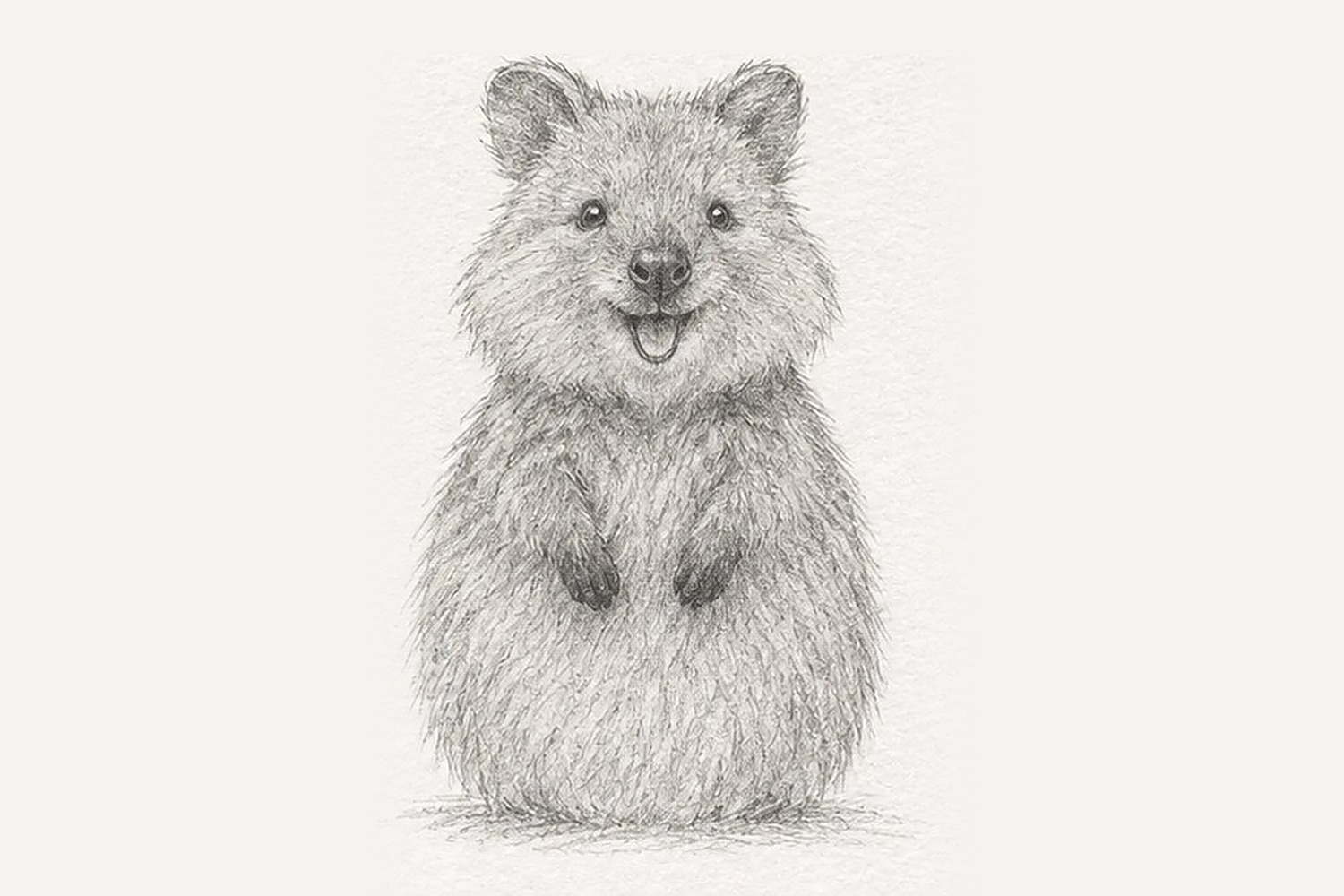
Quick answer: To draw a quokka, sketch a round head on top of a bigger oval body, add two small round ears, then a small dark nose, two eyes set wide apart and an open smile. Add tiny front paws held against the chest, and finish with short fur strokes and darker shading. Keep the ears small and the face round.
Quokkas are one of the easiest animals to draw badly and one of the most satisfying to draw well. Get the ears a bit too tall and you have a rabbit. Make the face too round and flat and it turns into a little bear. Get it right and you have the face half the internet already recognises.
This guide shows you how to draw a quokka in six steps, starting from two simple circles. It works for adults, teenagers and older kids, and you only need a pencil and an eraser. There’s a free printable at the end with the steps on one page and a practice page next to it.
At a glance
- Time: about 15–20 minutes for a first try.
- You need: a soft pencil (HB or 2B), an eraser, plain paper.
- Level: beginner. If you can draw a circle, you can do this.
- Shapes: a round head and an oval body, slightly overlapping.
- The quokka giveaways: small round ears, a short snout with a dark nose, an open smile and tiny hand-like paws.
- Free printable: step sheet plus a “your turn” practice page, download it here.
What you need to draw a quokka
A pencil and paper are enough. A soft pencil helps, because you can sketch lightly and then press harder for the final lines. HB is fine for the outline, and a 2B or 4B makes the fur and shading easier in the last step.
An eraser matters more than you’d think. The first two steps are guide shapes, and you’ll rub most of them out later. If you have a kneaded eraser, use it, since it lifts graphite without smudging the paper.
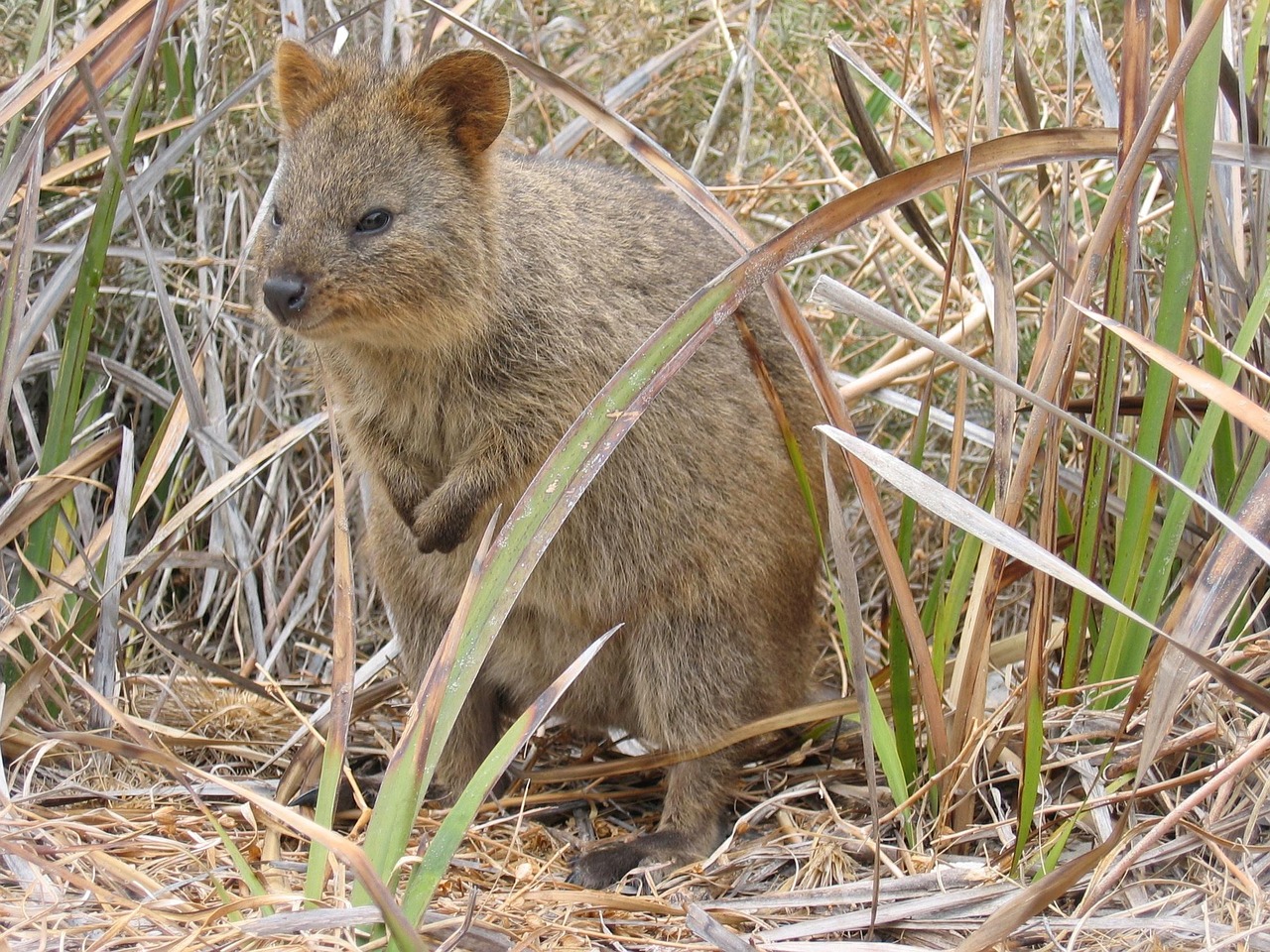
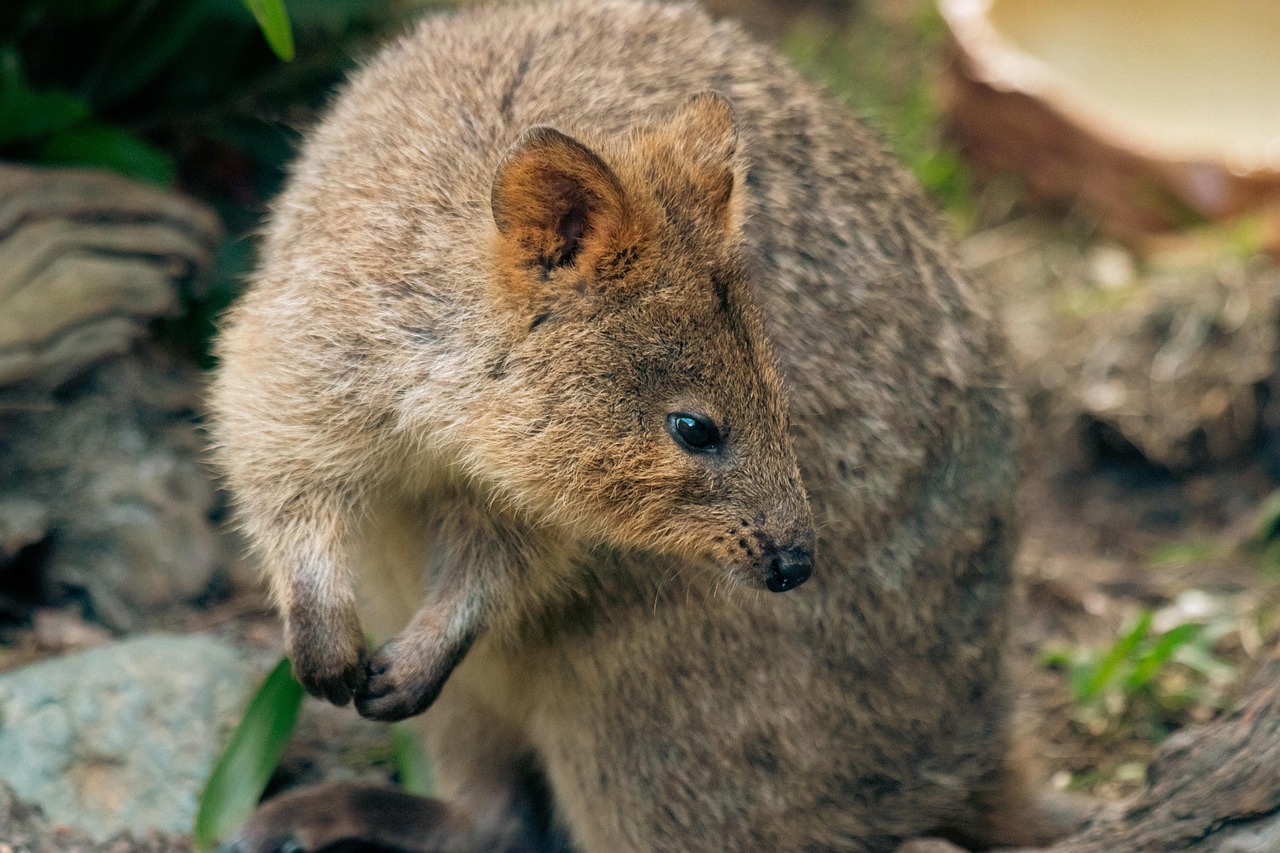
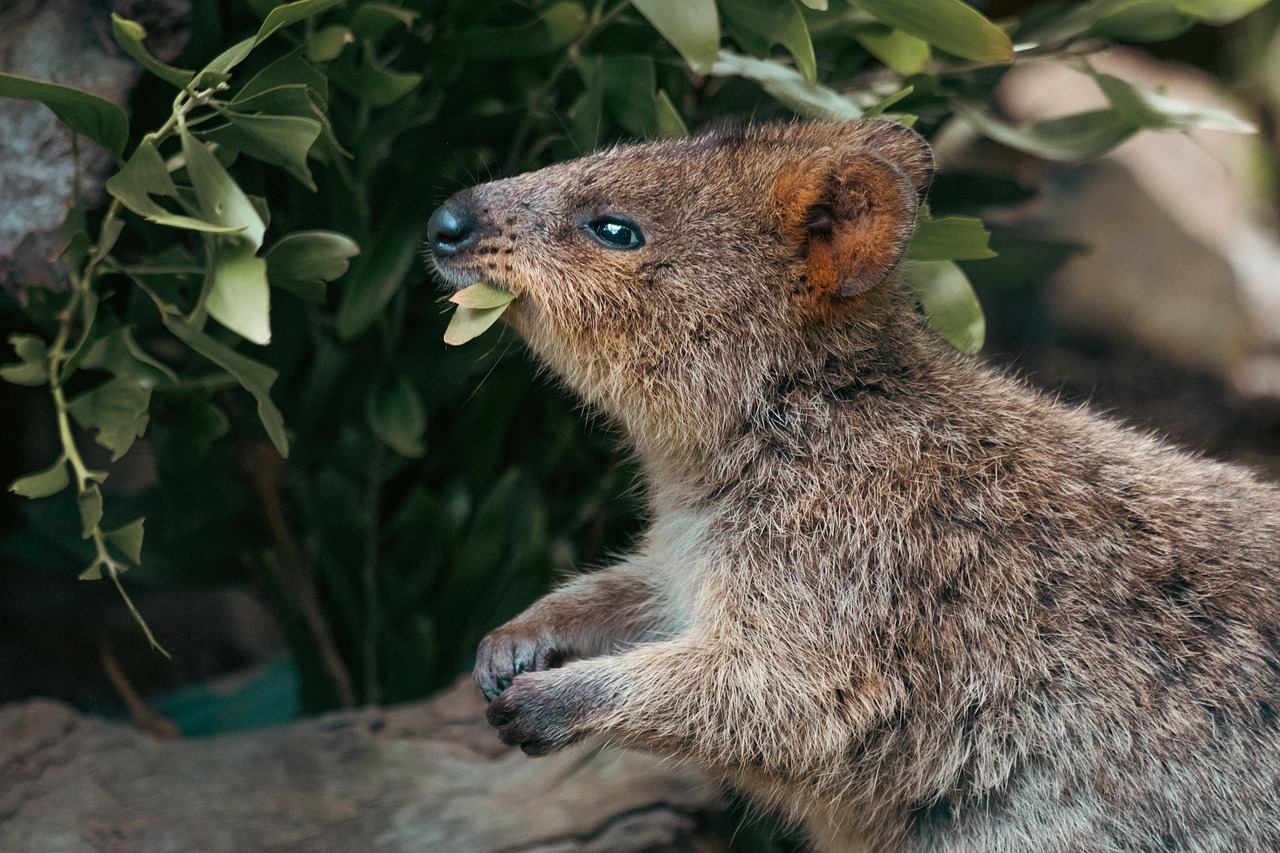
It also helps to look at a real quokka for a minute before you start. Notice how small the ears are, how the face is wider at the cheeks, and how the front paws are held close to the body like little hands.
How to draw a quokka, step by step
Draw every line lightly until step 5. It is much easier to fix a shape you can barely see.
Step 1: Draw two circles for the head and body
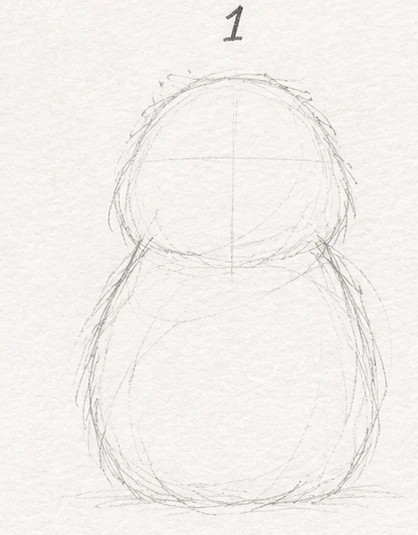
Start with a round head near the top of the page. Under it, draw a bigger oval for the body, so the two shapes overlap a little. A quokka sits like a soft, slightly slumped pear, so make the bottom of the body wider than the top.
Add two light guide lines across the face: one down the middle and one across, a little below halfway. The eyes will sit on the cross line and the nose just under it.
Step 2: Add two small round ears
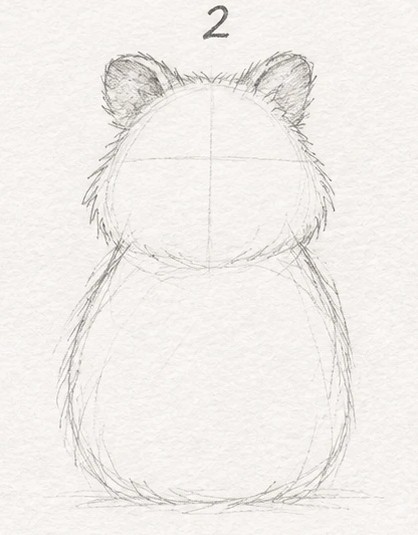
Put one ear on each top corner of the head. Keep them small, rounded and set fairly wide apart. This is the step that decides whether you end up with a quokka or a rabbit, so if in doubt, make them smaller.
Draw a second curve inside each ear for the inner ear. Let the outline of the head go slightly fluffy around the cheeks, with short broken strokes instead of one hard line.
Step 3: Draw the eyes, nose and smile
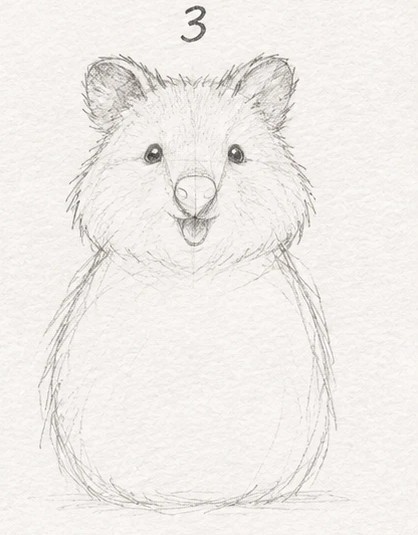
Place two small eyes on the cross line, quite far apart. Below them, in the middle, draw a short snout ending in a small rounded nose. Under the nose, draw a little open mouth that curves up at the corners.
That upturned mouth is what people recognise. The famous quokka “smile” is simply the shape of its mouth and jaw, which we explain in why quokkas smile, but on paper it is the single most important detail.
Step 4: Darken the face and shape the cheeks
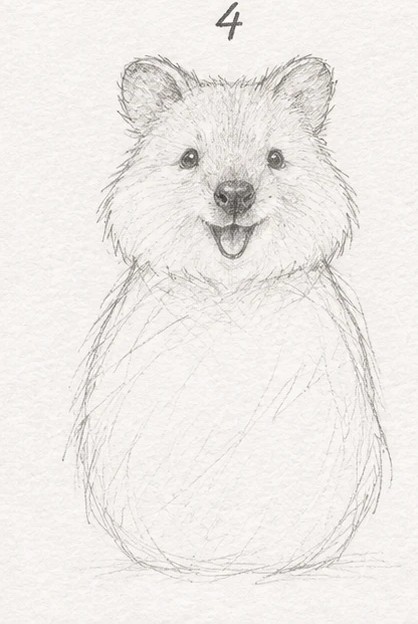
Now press a little harder. Fill in the nose, leaving a tiny white spot for shine, and darken the eyes the same way. Shade the inside of the mouth and add a small tongue.
Rub out the guide lines on the face and go round the cheeks with short fur strokes, so the face looks wider at the bottom than at the forehead. That wide, soft jaw is another strong quokka clue.
Step 5: Add the front paws
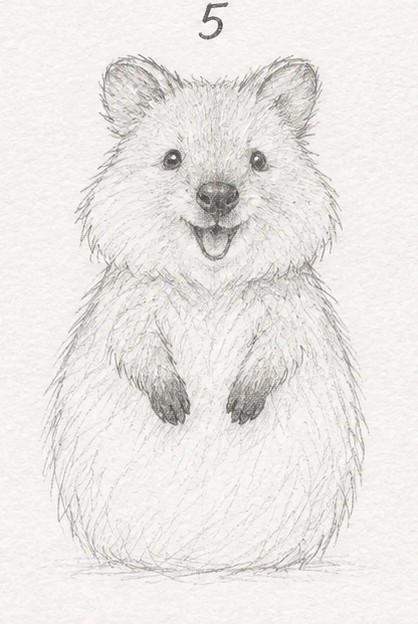
Quokkas often sit up with their front paws held against the chest, a bit like small hands. Draw two short arms coming down from under the chin, each ending in a small dark paw with a few tiny fingers.
Give the body outline the same soft, broken fur edge as the head, and rub out the part of the head circle that overlaps the body.
Step 6: Add fur and shading
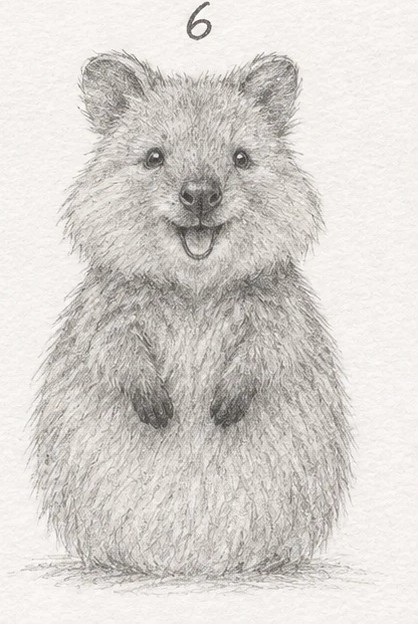
Finish with lots of short pencil strokes over the whole body, following the direction the fur grows: downwards on the body, outwards around the cheeks. Build the tone slowly, darker on the back and sides, lighter on the face and chest.
Add a soft shadow under the quokka so it sits on the ground instead of floating. If you want colour, real quokkas are a warm grey-brown, a little lighter on the face and belly, with darker paws.
What makes a drawing look like a quokka?
A few small details do most of the work. If your quokka looks like a different animal, this table usually shows why.
| Detail | Quokka | Looks like a bear | Looks like a rabbit |
|---|---|---|---|
| Ears | Small and round, wide apart | Round but set on a big flat head | Tall and long |
| Face | Round, wider at the cheeks, short snout | Big and flat, wide muzzle | Narrow, long face |
| Mouth | Small, open, corners turned up | Closed or straight | Small and split |
| Front paws | Tiny, hand-like, held at the chest | Big and heavy | Usually hidden |
| Body | Soft pear shape, sitting | Large and bulky | Long back legs |
Quokkas are small marsupials in the same family as kangaroos and wallabies, about the size of a cat. Keeping the whole animal small and rounded, with a short tail tucked out of sight, helps more than any single line.
Common mistakes when drawing a quokka
- Ears too big. The fastest way to turn a quokka into a rabbit. Shrink them.
- Eyes too close together. Set them wide, on the cross line.
- A flat, closed mouth. Without the upturned open mouth it reads as a generic rodent.
- Hard outlines everywhere. Use short broken strokes for the fur edge, and keep one firm line only where the shape needs it.
- Pressing hard too early. Guide lines you can’t erase are the main reason drawings look stiff.
How to draw a cute quokka for kids
For younger children, skip the fur and shading. Steps 1 to 4 already make a recognisable, cute quokka: two circles, two small ears, eyes, a nose and a smile. Colour it in light brown with crayons or felt tips and you’re done.
The printable’s practice page has the step 1 shapes already drawn in light grey, so kids can trace them and then try the second one freehand. It works well as a quiet classroom activity or a rainy-afternoon one at home.
Free printable: how to draw a quokka
Our free printable has two pages: the six steps with three quick tips, and a “your turn” page with a box to trace and a box to draw. It is sized for US Letter and prints fine on A4. It’s free for personal and classroom use.
Download the free printable (PDF)
If you draw one, we’d love to see it. Tag us on Pinterest as @quokkaplanet.
Gifts for people who like to draw
If you have a sketcher in the family, a few things from our shop fit nicely:
- I Love Quokkas & Painting T-Shirt ($25.99), a cosy tee for artists and art students.
- Ideas I Had While Doing Nothing Notebook ($24.99), a spiral notebook that works as a small sketchbook.
- Quokka Sticker Sheet ($12.99), for decorating the finished drawing or the sketchbook cover.
There are more in our art parodies, where famous paintings get a quokka, and in the Kids & Baby collection. Everything is printed after you order, and 3% of every order’s subtotal is set aside for quokka protection, as explained on Our Promise.
Frequently asked questions
How do you draw a quokka easily?
Start with a round head on top of a bigger oval body. Add two small round ears, two wide-set eyes, a short snout with a dark nose and an open, upturned smile. Finish with tiny front paws at the chest and short fur strokes.
What shape is a quokka’s head?
Round, and a little wider at the cheeks than at the forehead, with a short snout. Small rounded ears sit on the top corners. Keeping the snout short is what stops it looking like a rat.
What colour is a quokka?
Quokkas are a warm grey-brown, usually a little lighter on the face and belly, with darker paws and a dark nose. A light brown with a touch of grey works well for colouring in.
Why does my quokka look like a bear?
Usually the head is too big and flat, the muzzle too wide or the mouth closed. Make the head smaller than the body, keep the snout short and give it the small open smile with upturned corners.
Is this quokka drawing good for kids?
Yes. Younger children can stop after step 4 and colour it in, older kids can add the paws and fur. The free printable includes a tracing page with the starting shapes.
Can I use the printable in my classroom?
Yes, the printable is free for personal and classroom use. Print as many copies as you need. Please don’t sell it or share it as your own.
Related reading
- Why Do Quokkas Smile? (And Why It’s Not for Your Selfie)
- What Do Quokkas Eat? (And Why Your Sandwich Isn’t on the List)
- Quokka Gifts: 25 Gifts for Quokka Lovers
— Balázs & Dorina, Quokka Planet
Sources: Australian Museum, Rottnest Island Authority.
The step-by-step drawings in this article are AI-generated; the photos are from Pixabay.
From the shop
Wear the story
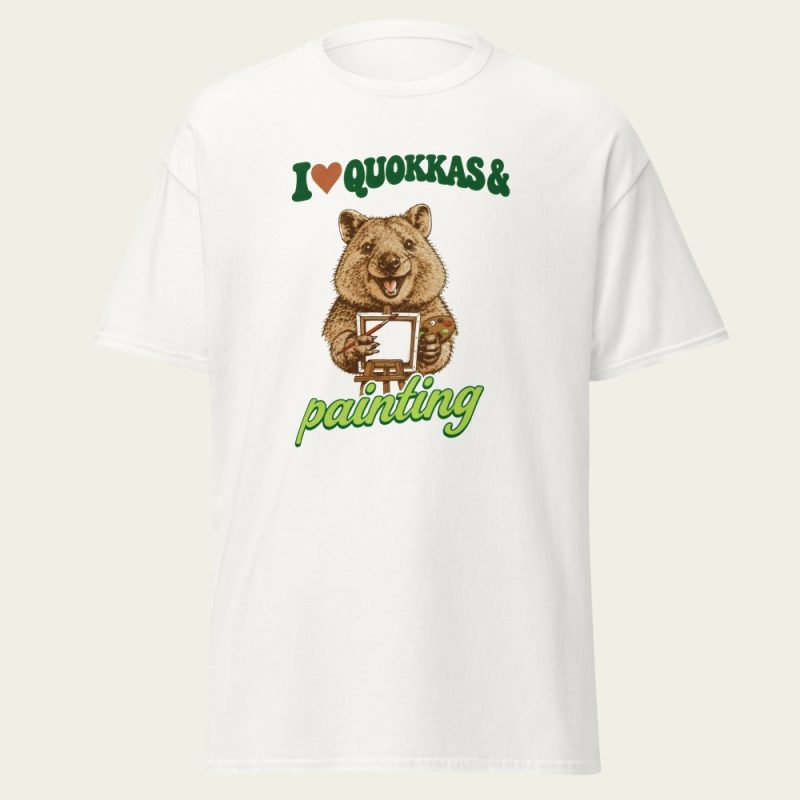 I Love Quokkas & Painting T-Shirt
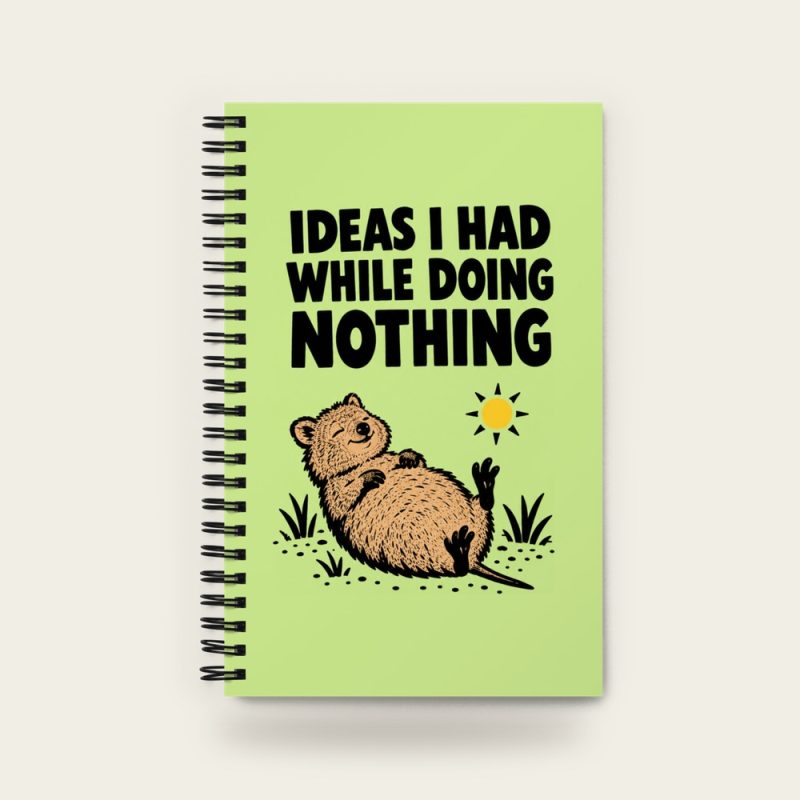 Ideas I Had While Doing Nothing Quokka Spiral Notebook
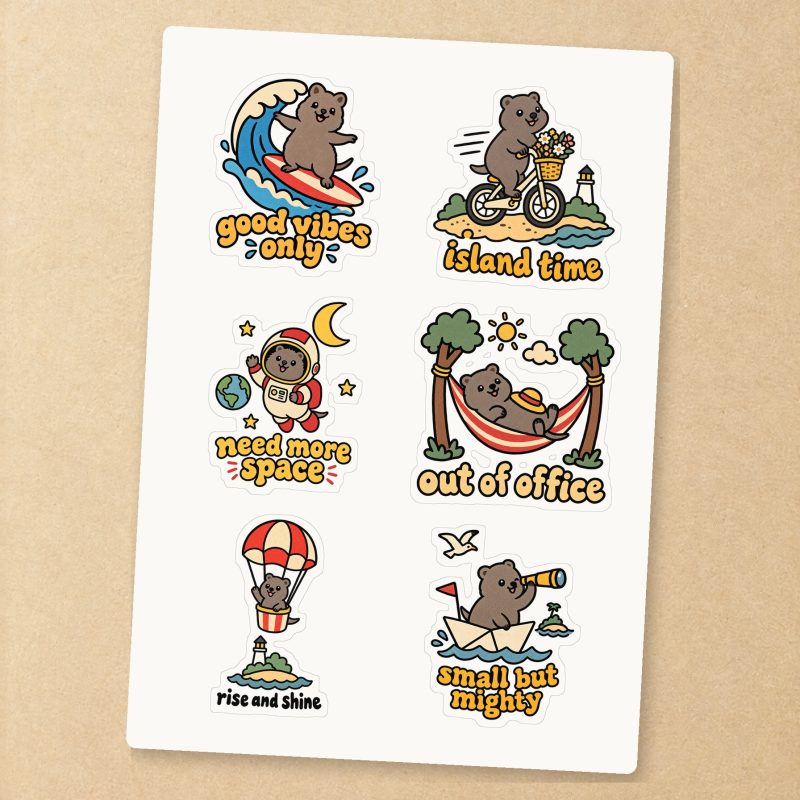 Quokka Sticker Sheet
Keep reading
 This social media photo cost a man $200 on Rottnest Island
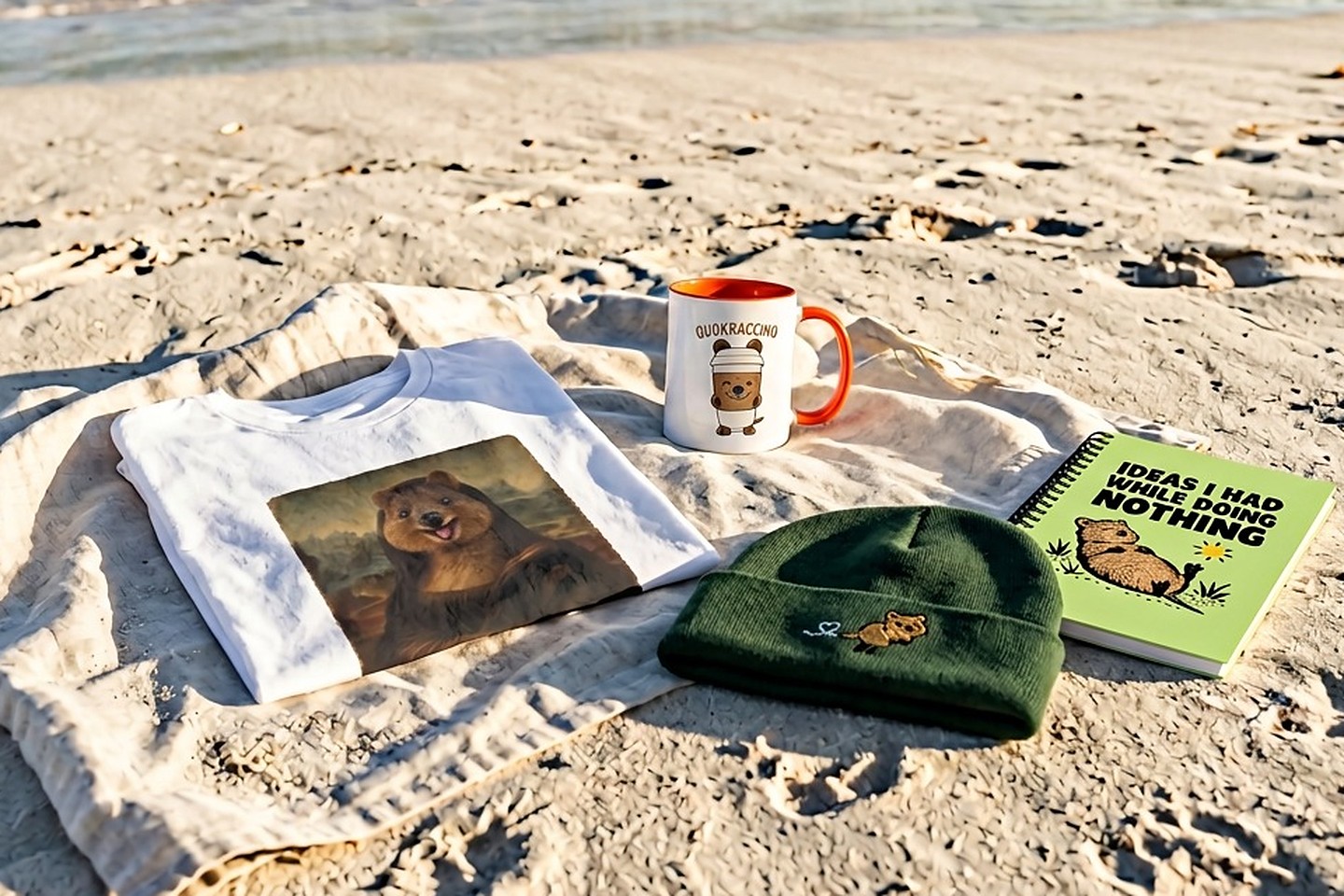 Quokka Gifts: 25 Gifts for Quokka Lovers (From $6.99)

Love loudly, touch nothing
Quokka tees, mugs and gifts, printed after you order. 3% of every order goes to quokka conservation.